Approximately 70 million years ago, dinosaurs roamed across the landscape of Madagascar. These dinosaurs and all of the other backboned animals that lived at the same time near the end of the Cretaceous Period are now extinct. We only know about them because they are preserved as spectacular fossils in the Berivotra area of northwestern Madagascar. Since 1993, paleontologists (scientists who study fossils) from Stony Brook University in the United States, in collaboration with researchers from the University of Antananarivo in Madagascar, have been excavating dinosaur and other fossils in the Berivotra area and studying them as part of an ongoing, large-scale research project.

Beelzebufo ampinga
Beelzebufo, known from various parts of the skull and a few from the skeleton, is the largest frog known, living or extinct. This species was over 16 inches long (not including the legs) and weighed up to 10 pounds. The largest frog on Madagascar today is just over four inches long.
The mammoth size of Beelzebufo prompted its discoverers to call it the “frog from hell.” They derived the genus name from the Greek word for devil (Beelzebub) and the Latin word for toad (bufo). The unique bony features of Beelzebufo, are similar to those of a group of frogs known as ceratophryines, which are now found solely in South America. Ceratophryines camouflage themselves in their surroundings and are sit-and-wait ambush predators, lunging out to snatch any unsuspecting prey that happens to wander by.
Artist: © Lucille Betti-Nash
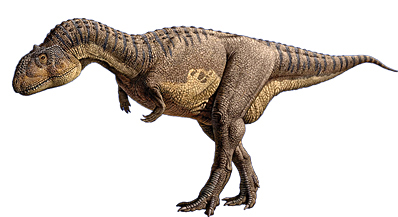
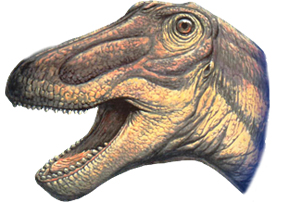
Majungasaurus crenatissimus
Majungasaurus was the top predator on the island of Madagascar in the latest Cretaceous. About 21 feet long, it was a very unusual theropod dinosaur and is the best known of a group known as abelisaurids.
Majungasaurus had a short snout, a thick skull roof, and a horn-like bump protruding from the top of its skull. The jaws were equipped with sharp, knife-like teeth designed to slice through flesh. The body of Majungasaurus was also unusual in that it had very short, powerful hind legs but extremely small front legs. The function of these diminutive forelimbs is unknown.
The closest relatives of Majungasaurus lived at approximately the same time in India and Argentina.
Artist: © Raul Martin
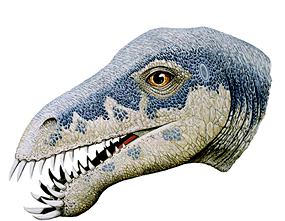
Masiakasaurus knopfleri
Masiakasaurus was a small predatory theropod dinosaur, measuring only about six feet in length. It belongs to a group known as noasaurids, which were generally much smaller and more slender than abelisaurids like Majungasaurus.
The teeth of Masiakasaurus are unique among dinosaurs. At the front of the jaws, the teeth are long and directed forward, perhaps to spear small prey, whereas those at the rear are smaller and more typical of meat-eating dinosaurs.
The species name knopfleri honors the musician Mark Knopfler, lead singer of the band Dire Straits, because it seemed that when his music was played in the fossil quarries, more bones of Masiakasaurus were uncovered.
Artist: © Bill Parsons
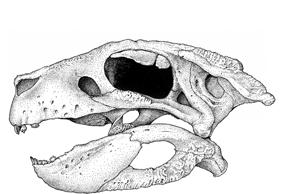
Simosuchus clarki
Simosuchus was a small, pug-nosed crocodile that belongs to a diverse group known as Notosuchia. Simosuchus was only about 2.5 feet long. It may be the most bizarre crocodile to have ever lived on the planet!
Unlike modern crocodiles, Simosuchus had a tall, rounded skull, eyes that faced toward the side, an extremely blunt snout, and leaf-shaped, multi-cusped teeth. This last feature suggests that Simosuchus was a plant-eater.
Simosuchus was built like a tank, complete with armor for protection against its many predators – dinosaurs and larger species of crocodiles. Its armor consisted of many bony plates embedded in the skin.
Artist: © Lucille Betti-Nash
Rapetosaurus krausei
Rapetosaurus is a titanosaurian sauropod dinosaur. Fully grown, Rapetosaurus would have been about 50 feet long. In general, sauropod dinosaurs are known from very fragmentary fossils, but most of the bones of Rapetosaurus are now known, including those of the skull.
This huge dinosaur had peg-like teeth that helped it to browse on plant matter, and had armor plates (known as “osteoderms”) that grew within its skin.
Artist: © Martk Hallett

